
Tell us about the job
Takes about a minute. No obligation.
A furnace repair in Smith County asks a contractor to account for what the system has already been through before settling on a cause. 285 severe weather events were recorded in Smith County, Texas between 2015 and 2024. At that rate, severe weather is a standing condition here, not a rare interruption, and components carry that load across every heating season. Heat exchangers and ignition assemblies absorb the brunt of repeated stress cycles, and in a county with this kind of weather record, a contractor typically finds wear distributed across several parts rather than isolated to one. That shapes both the diagnosis and what gets replaced.
Half the homes in Smith County, Texas were built in 1986 or earlier (2020-2024 ACS 5-year). Furnaces in houses that age are running on parts that were designed and catalogued long before current supply chains existed. When a contractor opens a unit here, the question that shapes the repair bill is whether a replacement component is still in production. If it is not, the job changes: sourcing becomes the work, and what looked like a standard fix turns into a decision about patching versus replacing the system.
The Parts of a Furnace a Contractor Checks First
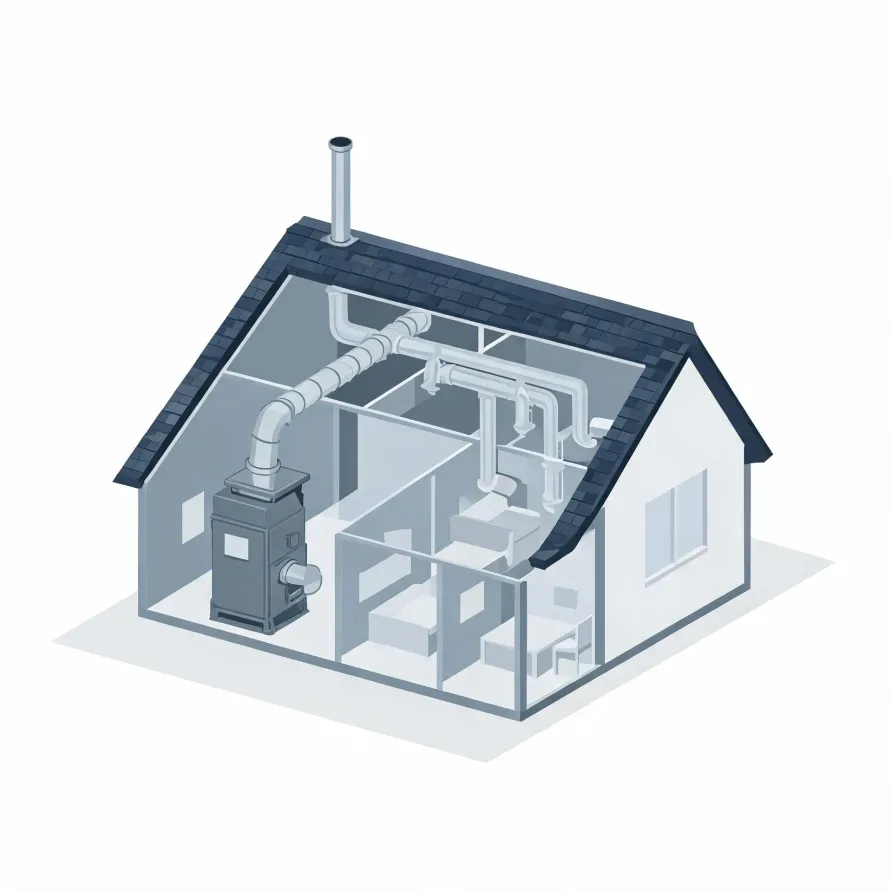
The heat exchanger sits at the core of the furnace cabinet, taking heat from combustion and passing it into the airstream. When it cracks or warps, combustion gases can enter the living space, which is why a contractor looks at it closely. The burner assembly, just below it, is where the fuel ignites, and a dirty or failed burner shows up as uneven flames, delayed ignition, or no heat at all.
The blower motor and its fan wheel sit in the lower section of the cabinet and push conditioned air out through the supply side. The inducer motor pulls exhaust gases out through the flue before each cycle starts. The control board ties these components together, and when it fails, the furnace often behaves erratically or stops responding to the thermostat entirely.
The drawing shows the general layout of a furnace system, and a licensed contractor determines which components and conditions apply to your specific house.
Find a contractor in Smith CountySmith County, Texas, by the numbers
285 severe weather events were recorded in Smith County, Texas between 2015 and 2024.
NOAA National Centers for Environmental Information, Storm Events Database, bulk CSV export, events 2015-01-01 through 2024-12-31.Half the homes in Smith County, Texas were built in 1986 or earlier (2020-2024 ACS 5-year).
U.S. Census Bureau, 2020-2024 American Community Survey 5-Year EstimatesSmith County, Texas holds 99,673 housing units (2020-2024 ACS 5-year).
U.S. Census Bureau, 2020-2024 American Community Survey 5-Year EstimatesOwners occupy 68.8% of the occupied homes in Smith County, Texas (2020-2024 ACS 5-year).
U.S. Census Bureau, 2020-2024 American Community Survey 5-Year EstimatesCodes & Standards Governing Furnace Repair in Smith County, Texas5 sourced rules and standards
What the Repair Visit Looks Like
Non-weatherized gas furnaces manufactured on or after November 19, 2015 must reach 80.0 percent AFUE.
Non-weatherized oil-fired furnaces manufactured on or after November 19, 2015 must reach 83.0 percent AFUE.
Mobile home gas furnaces manufactured on or after November 19, 2015 must reach 80.0 percent AFUE.
Non-weatherized gas furnaces manufactured on or after December 18, 2028 must reach 95.0 percent AFUE, up from the 80.0 percent minimum that applies to units manufactured before that date.
Licensing and Legal Requirements in Smith County, Texas
In Texas a person may not engage in air conditioning and refrigeration contracting unless that person holds a license issued under the state air conditioning and refrigeration contractor law.
Severe Weather Events in Smith County
Extreme weather puts real stress on furnace systems, shortening component life and pushing equipment toward failure at the worst time. How often that pressure hits depends entirely on where you live, which is why local repair demand in Smith County runs on local conditions.
285 severe weather events, 2015–2024. Source: NOAA National Centers for Environmental Information, Storm Events Database.