Tell us about the job
Takes about a minute. No obligation.
A contractor called out for a furnace repair in Cherokee County has to decide early whether the failure came from accumulated weather load or from something unrelated to climate. 134 severe weather events were recorded in Cherokee County, Texas between 2015 and 2024. At that rate, severe weather is a standing condition of operating here, and the heat exchanger, igniter, and pressure switches are the parts that carry that load most directly. A contractor looks at those first, because if weather stress drove the failure, the fix and the follow-up are different than if the unit simply aged out.
Furnace systems in houses this old have been through enough replacement cycles that what a contractor finds when the unit comes apart is rarely what the nameplate suggests. Half the homes in Cherokee County, Texas were built in 1987 or earlier (2020-2024 ACS 5-year). That history matters for repair because the parts a furnace of this era uses may belong to a product line that has since been discontinued, and a contractor has to confirm availability before a repair scope means anything. A heat exchanger crack or a failed inducer motor is a different job depending on whether the replacement part is on a shelf or a special order from a supplier who may not carry it at all.
The Parts of a Furnace a Contractor Checks First
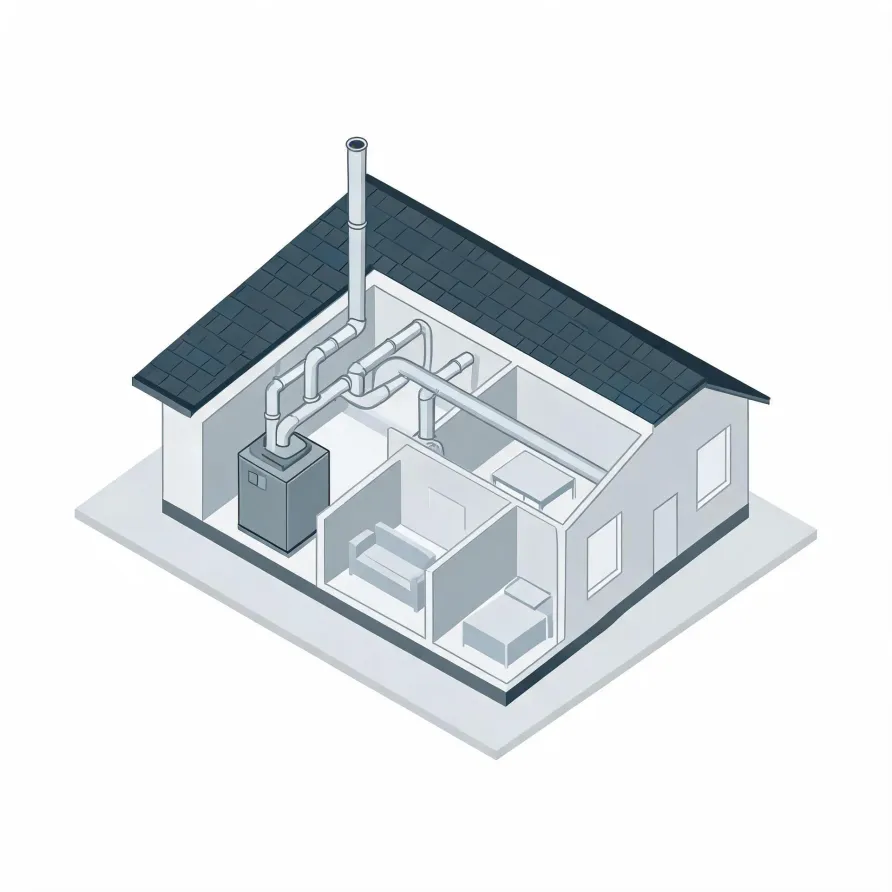
The heat exchanger sits at the heart of the furnace cabinet, inside the main unit in your utility room, basement, or closet. It is the piece that transfers heat to the air moving through your home, and when it cracks or corrodes, the furnace either shuts itself down or stops heating reliably. The burner assembly feeds directly into it, and a contractor will pull that apart early when heat output is weak or uneven.
The inducer motor and flue pipe sit at the top of the cabinet and pull combustion gases out of the heat exchanger and out of the house. The blower motor sits at the bottom and pushes conditioned air into your ducts. Both are common repair targets: a failed inducer triggers safety lockouts, and a worn blower motor shows up as weak airflow or a furnace that runs but barely moves heat.
The drawing shows a typical furnace layout, and a licensed contractor determines which components apply to the specific unit and installation in your home.
Get matched in Cherokee CountyCherokee County, by the numbers
134 severe weather events were recorded in Cherokee County, Texas between 2015 and 2024.
NOAA National Centers for Environmental Information, Storm Events Database, bulk CSV export, events 2015-01-01 through 2024-12-31.Half the homes in Cherokee County, Texas were built in 1987 or earlier (2020-2024 ACS 5-year).
U.S. Census Bureau, 2020-2024 American Community Survey 5-Year EstimatesCherokee County, Texas holds 21,053 housing units (2020-2024 ACS 5-year).
U.S. Census Bureau, 2020-2024 American Community Survey 5-Year EstimatesOwners occupy 74.0% of the occupied homes in Cherokee County, Texas (2020-2024 ACS 5-year).
U.S. Census Bureau, 2020-2024 American Community Survey 5-Year EstimatesCodes & Standards Covering Furnace Repair in Cherokee County, Texas5 sourced rules and standards
What Happens When the Contractor Arrives
Non-weatherized gas furnaces manufactured on or after November 19, 2015 must reach 80.0 percent AFUE.
Non-weatherized oil-fired furnaces manufactured on or after November 19, 2015 must reach 83.0 percent AFUE.
Mobile home gas furnaces manufactured on or after November 19, 2015 must reach 80.0 percent AFUE.
Non-weatherized gas furnaces manufactured on or after December 18, 2028 must reach 95.0 percent AFUE, up from the 80.0 percent minimum that applies to units manufactured before that date.
Licensing and Legal Requirements in Cherokee County, Texas
In Texas a person may not engage in air conditioning and refrigeration contracting unless that person holds a license issued under the state air conditioning and refrigeration contractor law.
Severe Weather Events in Cherokee County
Extreme weather puts real stress on furnace components, from heat exchangers to ignition systems, because equipment works hardest when conditions outside are worst. How often that stress hits depends on where you are, and Cherokee County has its own record.
134 severe weather events, 2015–2024. Source: NOAA National Centers for Environmental Information, Storm Events Database.