
Tell us about the job
Takes about a minute. No obligation.
A contractor diagnosing a furnace in Roberts County has to sort out what actually drove the failure before they can price the repair. 110 severe weather events were recorded in Roberts County, Texas between 2015 and 2024. At that rate, severe weather is a real but occasional presence, not a constant grind on heating equipment. A heat exchanger or igniter that has given out is more likely showing its age or the effects of skipped service than carrying storm-related wear. The contractor checks both, but maintenance history is where the explanation usually sits.
Ductwork and furnaces installed in stock this old have often been patched, adapted, and patched again over the decades since the house was first wired and vented. Half the homes in Roberts County, Texas were built in 1966 or earlier (2020-2024 ACS 5-year). That history shows up inside the unit: heat exchangers, igniters, and control boards from systems of that vintage are frequently discontinued, which means a contractor opens the furnace before pricing anything, because what the repair actually costs depends on whether the part it needs still exists. A substitute that fits the housing but runs at different tolerances changes the scope of the job.
The Parts of a Furnace a Contractor Checks First
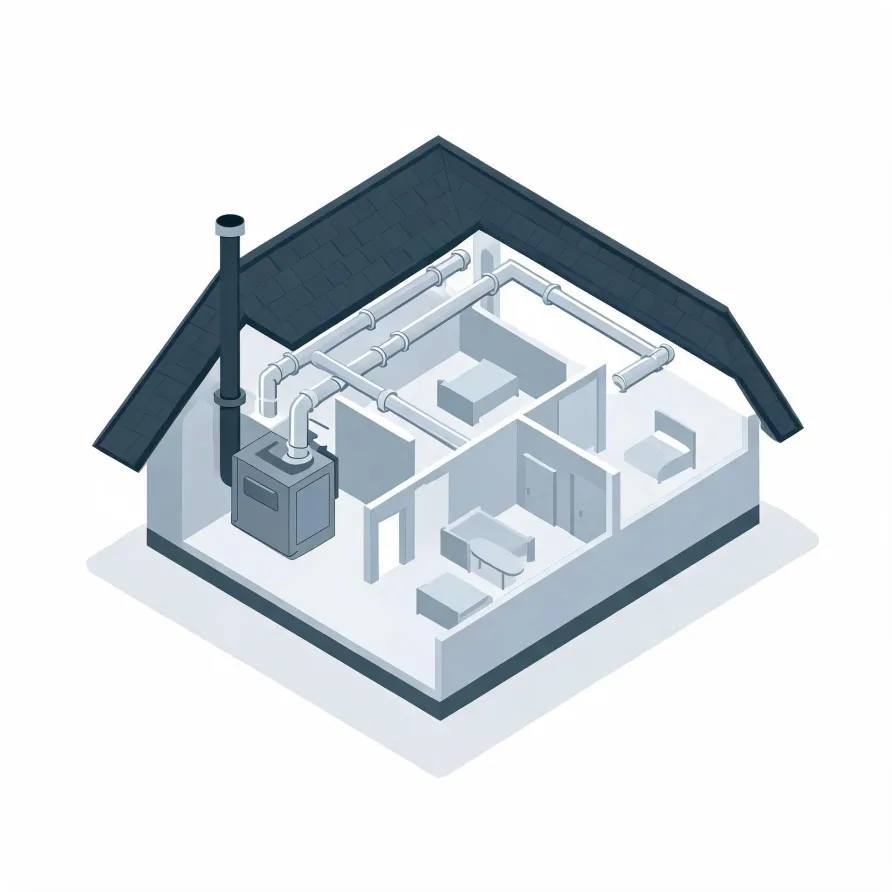
The heat exchanger sits inside the furnace cabinet in the utility room or closet and is the piece a contractor looks at closely when a furnace runs but does not heat well, or when carbon monoxide is a concern. The burners sit just below it and are the first stop when the furnace fails to ignite or the flame behaves erratically.
The blower motor and its wheel sit at the base of the cabinet and push conditioned air into the supply side of the duct system. The draft inducer motor sits at the top of the heat exchanger, and the control board runs across the back wall of the cabinet, managing every sequence the furnace follows from call for heat to shutdown.
The drawing shows a representative furnace layout, and a licensed contractor determines which components apply to the specific equipment and installation in your home.
Find a contractor in Roberts CountyRoberts County, by the record
110 severe weather events were recorded in Roberts County, Texas between 2015 and 2024.
NOAA National Centers for Environmental Information, Storm Events Database, bulk CSV export, events 2015-01-01 through 2024-12-31.Half the homes in Roberts County, Texas were built in 1966 or earlier (2020-2024 ACS 5-year).
U.S. Census Bureau, 2020-2024 American Community Survey 5-Year EstimatesRoberts County, Texas holds 393 housing units (2020-2024 ACS 5-year).
U.S. Census Bureau, 2020-2024 American Community Survey 5-Year EstimatesOwners occupy 85.1% of the occupied homes in Roberts County, Texas (2020-2024 ACS 5-year).
U.S. Census Bureau, 2020-2024 American Community Survey 5-Year EstimatesCodes & Standards Governing Furnace Repair in Roberts County, Texas5 sourced rules and standards
What Furnace Repair Looks Like in Roberts County
Non-weatherized gas furnaces manufactured on or after November 19, 2015 must reach 80.0 percent AFUE.
Non-weatherized oil-fired furnaces manufactured on or after November 19, 2015 must reach 83.0 percent AFUE.
Mobile home gas furnaces manufactured on or after November 19, 2015 must reach 80.0 percent AFUE.
Non-weatherized gas furnaces manufactured on or after December 18, 2028 must reach 95.0 percent AFUE, up from the 80.0 percent minimum that applies to units manufactured before that date.
Licensing and Legal Requirements in Roberts County, Texas
In Texas a person may not engage in air conditioning and refrigeration contracting unless that person holds a license issued under the state air conditioning and refrigeration contractor law.
Severe Weather History in Roberts County
Extreme weather puts real strain on furnace systems, cycling them hard and fast through conditions they were built to handle over years, not days. That wear is local, and so is the repair work it creates.
110 severe weather events, 2015–2024. Source: NOAA National Centers for Environmental Information, Storm Events Database.