
Tell us about the job
Takes about a minute. No obligation.
A contractor diagnosing a furnace repair in Washington County has to account for what this area's weather actually puts equipment through. 36 severe weather events were recorded in Washington County, Texas between 2015 and 2024. At that rate, heat exchangers, igniters, and pressure switches accumulate stress from repeated thermal cycling beyond what normal seasonal demand produces. A part that looks worn tells a contractor less than a part that looks worn in a specific way. That distinction changes which component gets replaced and what the contractor recommends checking on the next visit.
Furnace systems in housing this old have often outlasted the original parts supply once or twice already. Half the homes in Washington County, Texas were built in 1989 or earlier (2020-2024 ACS 5-year). That means a contractor opening a failed furnace here has to identify the exact component, then work out whether it is still in production and what the lead time is before a repair scope can be priced. A part that appears on a spec sheet may take weeks to source, or may have no current equivalent, which pushes the job toward a different repair path entirely.
The Parts of a Furnace a Contractor Checks First
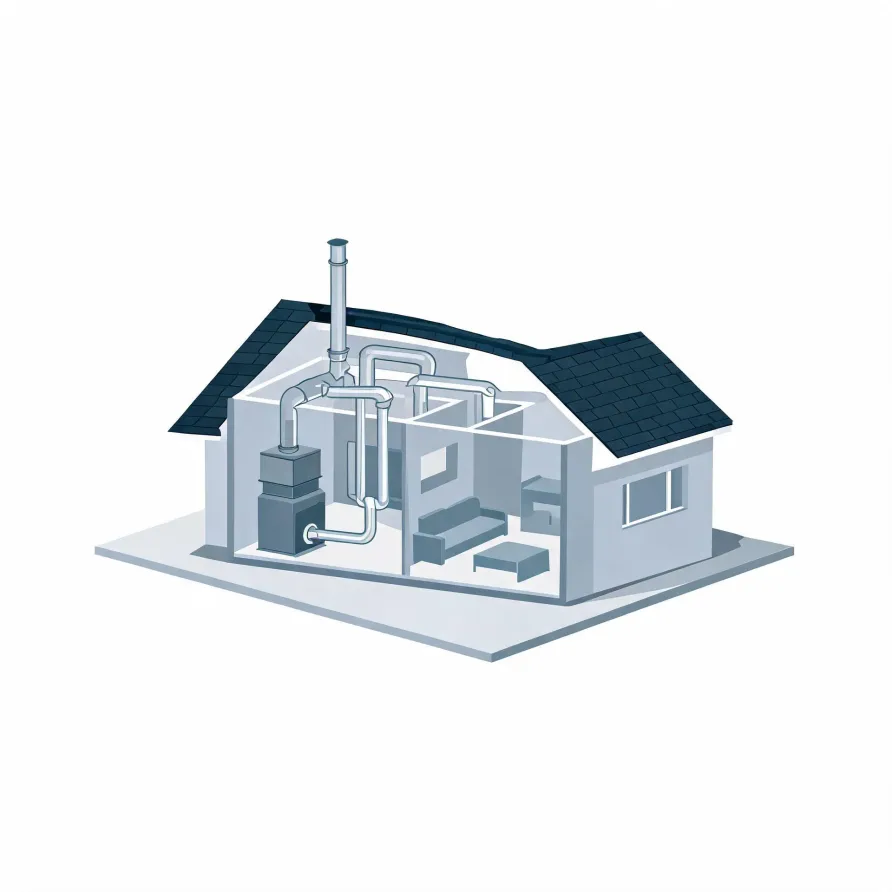
The heat exchanger sits at the core of the furnace cabinet and is the piece a contractor reaches first when the system is producing too little heat or cycling off early. The burners fire just below it, and a cracked exchanger or a dirty burner assembly will show up in the flame pattern before anything else.
The blower motor and its fan wheel push conditioned air into the supply side of the house. The draft inducer, mounted at the top of the cabinet near the flue outlet, pulls combustion gases out. The control board sits behind the access panel and governs the sequence every other component follows, so a fault on the board can look like a failure anywhere in the system.
The drawing shows a typical furnace layout, and a licensed contractor determines which components apply to the specific equipment and installation in your home.
Find a contractor in Washington CountyWashington County, TX, by the numbers
36 severe weather events were recorded in Washington County, Texas between 2015 and 2024.
NOAA National Centers for Environmental Information, Storm Events Database, bulk CSV export, events 2015-01-01 through 2024-12-31.Half the homes in Washington County, Texas were built in 1989 or earlier (2020-2024 ACS 5-year).
U.S. Census Bureau, 2020-2024 American Community Survey 5-Year EstimatesWashington County, Texas holds 17,642 housing units (2020-2024 ACS 5-year).
U.S. Census Bureau, 2020-2024 American Community Survey 5-Year EstimatesOwners occupy 69.8% of the occupied homes in Washington County, Texas (2020-2024 ACS 5-year).
U.S. Census Bureau, 2020-2024 American Community Survey 5-Year EstimatesCodes & Standards Governing Furnace Repair in Washington County, Texas5 sourced rules and standards
What HVAC Repair Looks Like in Washington County
Non-weatherized gas furnaces manufactured on or after November 19, 2015 must reach 80.0 percent AFUE.
Non-weatherized oil-fired furnaces manufactured on or after November 19, 2015 must reach 83.0 percent AFUE.
Mobile home gas furnaces manufactured on or after November 19, 2015 must reach 80.0 percent AFUE.
Non-weatherized gas furnaces manufactured on or after December 18, 2028 must reach 95.0 percent AFUE, up from the 80.0 percent minimum that applies to units manufactured before that date.
What Texas Law Requires in Washington County
In Texas a person may not engage in air conditioning and refrigeration contracting unless that person holds a license issued under the state air conditioning and refrigeration contractor law.
Severe Weather Events in Washington County
Extreme weather puts real hours on a furnace, cycling it harder and more often than mild conditions ever would. How much stress local weather adds to heating equipment is a Washington County question, which is why repair needs here look different from those elsewhere.
36 severe weather events, 2015–2024. Source: NOAA National Centers for Environmental Information, Storm Events Database.