Tell us about the job
Takes about a minute. No obligation.
A contractor diagnosing a furnace in Knox County has to decide whether the system wore out or was worked to death, and the weather record here helps set that baseline. 79 severe weather events were recorded in Knox County, Texas between 2015 and 2024. At that rate, severe weather is an occasional presence, not a constant one. A furnace that has failed here has almost certainly failed from age, poor servicing, or a weak installation rather than from the accumulated load of brutal seasons. The contractor checks heat exchangers, igniters, and blower components for the kind of gradual deterioration that follows years of deferred maintenance.
Parts availability is what settles most furnace repair calls in Knox County. Half the homes in Knox County, Texas were built in 1966 or earlier (2020-2024 ACS 5-year). A house that old has seen more than one heating system come and go, and whatever is running now may be drawing on a parts supply that manufacturers have already wound down. When a contractor opens the unit, the question is whether what is worn or failed can still be ordered, and if not, what that means for the repair bill versus a replacement. That answer does not come from the permit date.
The Parts of a Furnace a Contractor Checks First
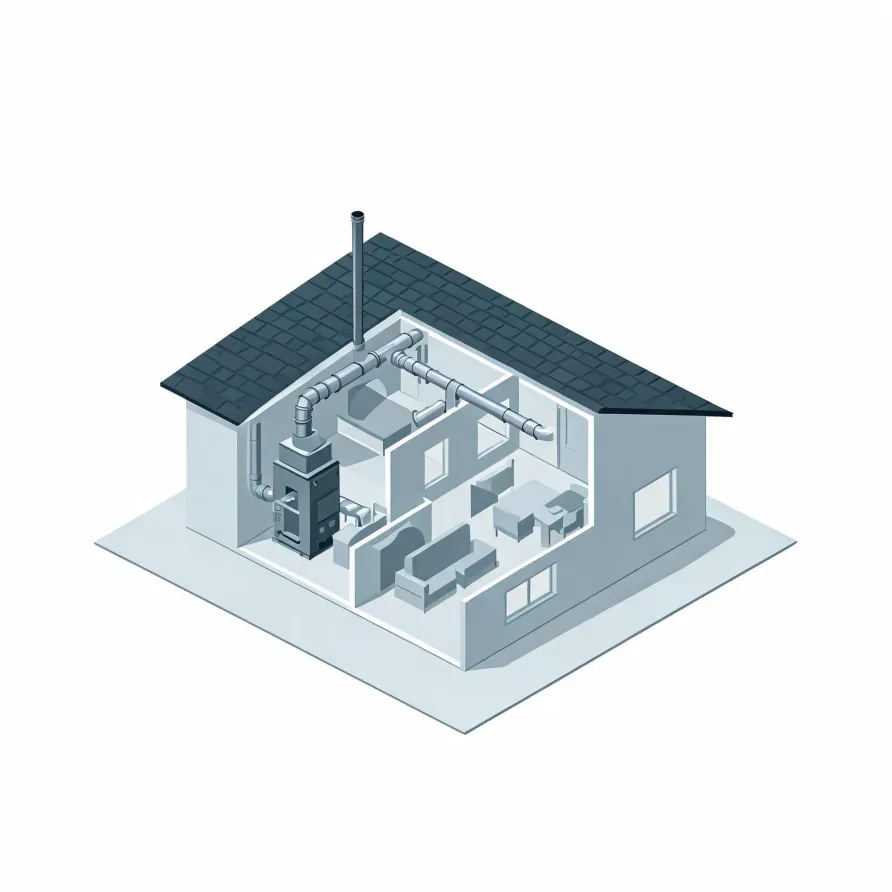
The heat exchanger sits inside the furnace cabinet, which lives in a basement, utility closet, or garage, and it is the part that transfers heat to the air moving through your home. Cracks or corrosion here are serious, and a contractor will inspect it closely. The burners sit directly below it and are the first place to look when ignition is weak or uneven.
The blower motor and its fan wheel sit in the lower half of the cabinet and push conditioned air into the supply ducts. The control board, also inside the cabinet, runs the sequence of operation, and faults there can mimic problems in other components. The flue pipe runs from the cabinet to an exterior vent and is checked for blockages or separation that would keep combustion gases from clearing.
The drawing shows a general layout of a furnace system, and a licensed contractor determines which components need attention in your specific home.
Find a contractor in Knox CountyKnox County by the numbers
79 severe weather events were recorded in Knox County, Texas between 2015 and 2024.
NOAA National Centers for Environmental Information, Storm Events Database, bulk CSV export, events 2015-01-01 through 2024-12-31.Half the homes in Knox County, Texas were built in 1966 or earlier (2020-2024 ACS 5-year).
U.S. Census Bureau, 2020-2024 American Community Survey 5-Year EstimatesKnox County, Texas holds 1,804 housing units (2020-2024 ACS 5-year).
U.S. Census Bureau, 2020-2024 American Community Survey 5-Year EstimatesOwners occupy 77.4% of the occupied homes in Knox County, Texas (2020-2024 ACS 5-year).
U.S. Census Bureau, 2020-2024 American Community Survey 5-Year EstimatesCodes & Standards Governing Furnace Repair in Knox County, Texas5 sourced rules and standards
What HVAC Repair Looks Like in Knox County
Non-weatherized gas furnaces manufactured on or after November 19, 2015 must reach 80.0 percent AFUE.
Non-weatherized oil-fired furnaces manufactured on or after November 19, 2015 must reach 83.0 percent AFUE.
Mobile home gas furnaces manufactured on or after November 19, 2015 must reach 80.0 percent AFUE.
Non-weatherized gas furnaces manufactured on or after December 18, 2028 must reach 95.0 percent AFUE, up from the 80.0 percent minimum that applies to units manufactured before that date.
Licensing and Legal Requirements in Knox County, Texas
In Texas a person may not engage in air conditioning and refrigeration contracting unless that person holds a license issued under the state air conditioning and refrigeration contractor law.
Severe Weather Events in Knox County
Extreme weather puts real strain on furnaces and the systems that support them. How hard equipment has to work, and how often it needs repair, is shaped by what the local climate actually does.
79 severe weather events, 2015–2024. Source: NOAA National Centers for Environmental Information, Storm Events Database.